“You’ve probably come across a similar sensational headline recently, in the newspaper, a magazine, or online. Libelle, NOS, Foodwatch, and De Telegraaf are full of exciting titles about the artificial sweetener aspartame possibly being more carcinogenic than expected.”
What’s going on? Is aspartame, the sweetener found in beverages like Coca-Cola, something we should be concerned about?
What is aspartame?
Aspartame is a sweetener that is approximately 200 times sweeter than sugar and contains minimal calories. It is primarily used in light beverages, and one might think it could be a powerful tool against overweight. However, people find aspartame concerning, mainly because it is an artificial substance. This means it is produced in a factory rather than occurring naturally.
Is natural then better?
Many people assume that if something comes from nature, it is automatically safer and/or better. This idea is called ‘the naturalistic fallacy’ and is a misconception. For example, consider the fly agaric mushroom, which is entirely natural but also highly poisonous. Therefore, we cannot simply state that natural substances are inherently safer. We must evaluate each product/substance individually.
The dose makes the poison.
It’s not just about determining if something is toxic, but also at what dose a product becomes harmful. Essentially, it’s not only about determining if something is toxic, but from what dose a product becomes harmful. Take water, for example. If you drink too much water, you risk water intoxication, but that’s not a reason to advise against drinking water altogether. But where is that limit? To investigate when a product or substance becomes harmful, animal experiments are usually conducted. The goal is to find the highest daily intake dose without negative health effects. This amount is called the NOAEL (No-Observed-Adverse-Effect Level) and is often expressed in milligrams or even micrograms per kilogram of body weight.
Because a substance may be more harmful to humans than to animals, we divide this NOAEL by 10. Additionally, certain individuals may be more sensitive to certain substances, such as elderly babies, pregnant women, or people who are ill. For this reason, the number is divided by 10 again, resulting in a safety margin of 100. This final number is called the Acceptable Daily Intake (ADI).
What about aspartame?
When it comes to the ADI of aspartame, it is set at 40 mg per kilogram of body weight. For soft drinks, the maximum allowed concentration is 600 mg per liter – it can be less as well. For example, Coca-Cola Light contains 529 mg per liter, and Coca-Cola Zero contains 245 mg per liter. Based on the maximum limit (600), this means that as an adult weighing 70 kg, you could theoretically drink 4.7 liters of diet soda daily. Hypothetically!
But what about those headlines? Has anything important changed?
The WHO advice: potentially carcinogenic
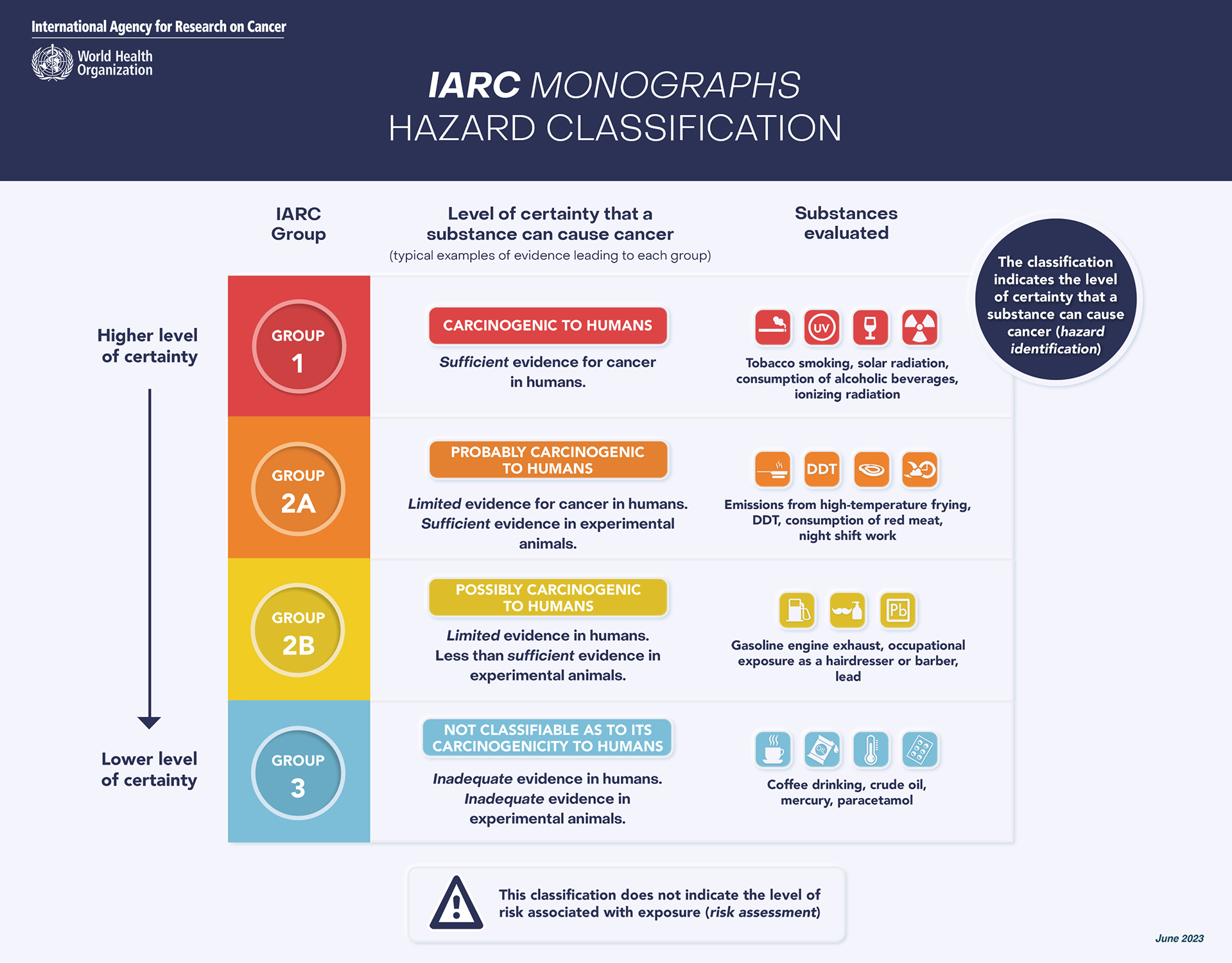
On July 14, the World Health Organization (WHO) classified aspartame as ‘potentially carcinogenic to humans’ (classification 2B). A change that initially sounds more serious than it is. Substances classified under this category are those for which there is limited but not convincing evidence of an association with cancer. The evidence is considered ‘limited’ when there are issues with, for example, the size or design of the studies or when it contradicts the overall evidence. Essentially, it’s a classification that states a substance is safe for consumption but emphasizes the need for more and better research.
Without being aware of it, chances are you regularly consume products falling under this classification or higher. For example, pickles and Aloe Vera fall under the 2B classification, while red meat, (too) hot coffee/tea, and fried foods fall under classification 2A (probably carcinogenic), and even your enjoyable beers and/or wines fall under classification 1 (clearly carcinogenic).
Conclusion
At BOOSTClubs, we strongly advocate for a mostly unprocessed eating pattern. When it comes to beverages, we recommend drinking as much water as possible instead of soda. However, if you really don’t want to miss out on soda and it helps you maintain your new lifestyle, then the diet/light variant (sweetened with aspartame) is still a safe alternative to sugar-sweetened drinks. It’s also a convenient method to reduce your calorie intake! And as a final note, perhaps the most important tip for today: take headlines (about food) with a grain of salt and always check the source.
Sources
- Scientists make shocking discovery about aspartame: sweetener found to be highly carcinogenic – Libelle
- Aspartame advice unchanged, but ‘limited evidence’ for link with cancer – NOS
- WHO: “Aspartame may be carcinogenic” – Foodwatch
- WHO researchers: ‘Sweetener aspartame potentially carcinogenic’ – De Telegraaf