Many women report that losing weight becomes increasingly difficult as they age, especially after menopause. Interestingly, this isn’t just true for women; men also find it increasingly challenging to lose weight as they get older. In our previous blog on metabolism, we explained that metabolism doesn’t actually decrease significantly from your 20s to your 60s, and difficulty losing weight appears to be more of a lifestyle issue.
Of course, as a woman, there’s an additional challenge in the form of menopause and all the hormonal changes that come with it. But what exactly is the effect of those hormones?
The Domino Effect of Menopausal Symptoms
Menopause marks the final period before reaching menopause. We define menopause as occurring 12 months after your last menstruation. Leading up to this point, your menstruation may become irregular, and you may experience symptoms such as hot flashes and/or night sweats.
Although menopause can bring about various other physical and mental symptoms, the domino hypothesis suggests that these symptoms can be traced back to the two mentioned above. For instance, hot flashes and night sweats can lead to sleep disturbances, and sleep problems, in turn, can lead to feelings of depression. While the theory isn’t foolproof and can’t fully explain all symptoms, you can certainly imagine that especially sleep deprivation has a negative effect on your overall physical and mental well-being.
Hidden Changes – The Effect of Estrogen
In addition to the changes you notice immediately, menopause also brings about some changes that you may not immediately notice. Your estrogen levels decrease, which has several negative health effects, such as: loss of muscle mass, decreased bone density, higher risk of heart disease, and changes in fat distribution, namely more abdominal fat instead of fat in your lower body.
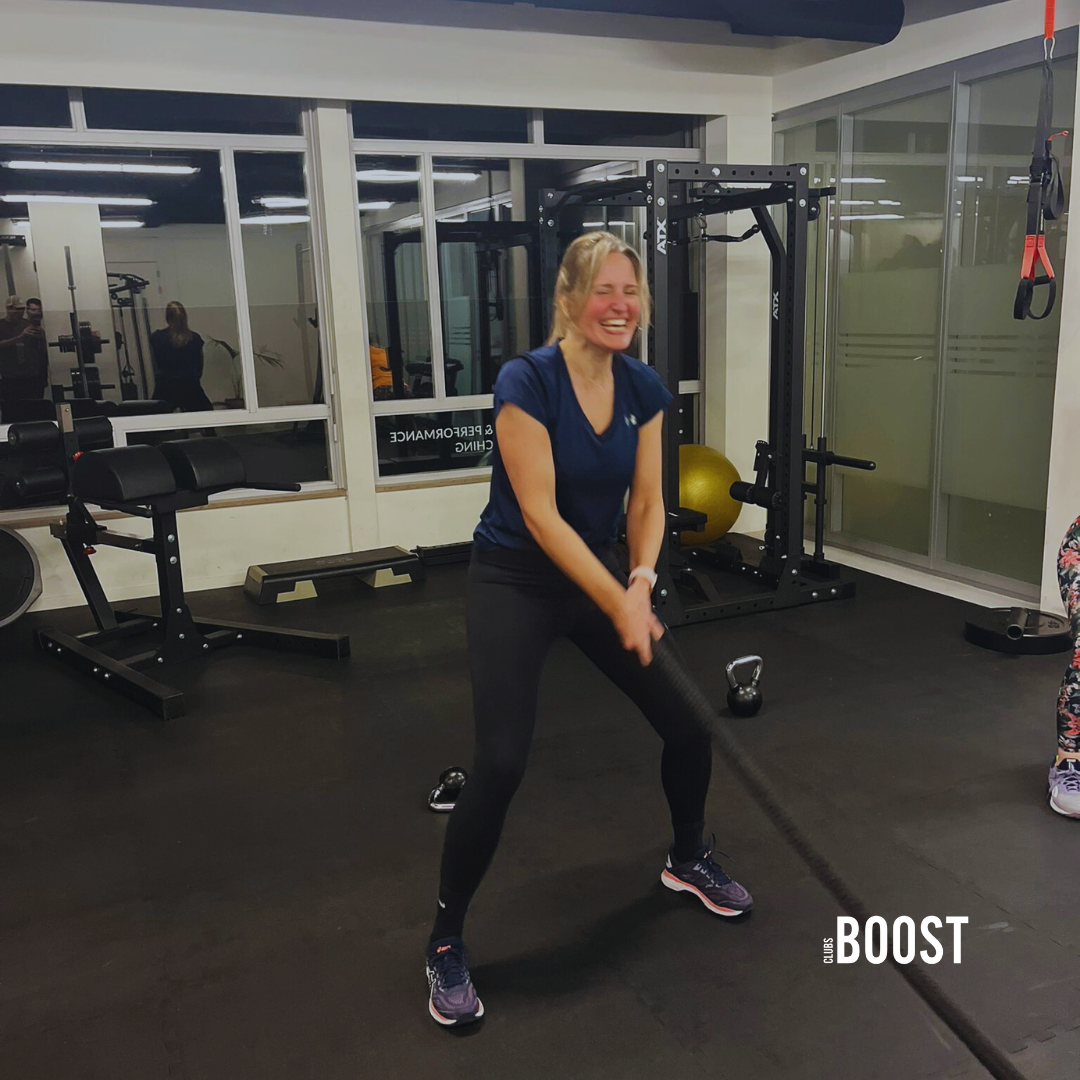
That does sound quite negative, doesn’t it? However, you might have noticed that a decrease in metabolism (burning calories) isn’t mentioned among these effects. Indirectly, your metabolism can indeed change during menopause because muscle mass burns about 13 calories per kg per day. But even considering that, we can’t solely attribute the extra difficulty in weight loss to this factor. Besides, the 13 calories from muscle mass are almost negligible, and muscle loss can be prevented with strength training. So, if you’re diligently coming to BOOST twice a week, you don’t need to worry about this at all!
And to add an optimistic spin to the above, be sure to read this refreshingly positive blog from Origin about menopause.
Sleep, mood, and hot flashes
Losing weight during menopause isn’t necessarily physiologically more difficult. In theory, it’s entirely possible. But… why does it often feel that way? We already know from people without menopausal symptoms that sleep deprivation can have a negative effect on your weight loss journey.
Furthermore, fluctuating mood and hot flashes can also have a detrimental effect on sticking to a nutrition or training plan. So, despite your metabolism not necessarily hindering you, there are certainly aspects that make weight control more challenging.
Why does your figure change?
Another change after menopause that seemingly makes it more difficult to stay in shape is the altered fat distribution. Due to decreased estrogen levels, women tend to store more fat around the abdomen rather than in the lower body after menopause. Before menopause, about 5-8% of total body fat is located in this area, whereas after menopause, it can increase to 15-20%! As a result, you may develop a more apple-shaped figure instead of the pear-shaped figure you might have been accustomed to. While your metabolism doesn’t change much, it can still be challenging to maintain the same figure. To achieve the same shape as before, you would need to have a lower overall body fat percentage and build more muscle mass in your legs and buttocks.
Of course, this isn’t a unique problem. We all age, develop more wrinkles, and go gray. Men may experience hair loss and also find it more difficult to maintain the athletic physique they may have had in their younger years. The question of whether we should embrace or fight this process is almost a philosophical issue—one that we can’t answer for you. What we do know is that people are more likely to stick to a nutrition plan when health is the driving force rather than when the goal is appearance-driven!
Conclusion
So, now we understand how weight loss works during menopause, but what do we do with this knowledge? Despite the additional challenges that come with menopause, it’s important to know that weight loss during and/or after menopause is still possible. Feeling like your weight gain is predetermined by your age and therefore beyond your control can have a negative impact on sticking to your nutrition or training plan. Therefore, it’s crucial to recognize that, despite the extra challenges, you still have control over your body and health.
If you need guidance during or after menopause, our trainers are familiar with the accompanying physiological changes and can support you through this process.
If you’re experiencing significant symptoms during menopause, you may consider using hormone therapy. This is a controversial topic, and the final word has not yet been said regarding the benefits versus the side effects. You can discuss this option with your doctor. If you want to learn more about hormones during menopause, the book “Oestrogen Matters” extensively covers this topic.